First, Some Vocabulary
Country
Government
State
Nation
The actual land or territory controlled by a government
The apparatus or organization that defends and establishes laws over that territory and its inhabitants
The bureaucracy in charge of implementing the laws and policies of the government
The people who identify collectively with one another.
The Medieval World
- Small states

The Medieval World
Feudal Bonds

The Medieval World
Orders of society:
- Church,
- Nobility,
- Everyone else.

The Medieval World, the University, and the Monastery
Early Medieval Society (500-1000) = Monastery
High Middle Ages (1000-1250) = University
Feudal Elites
Monasteries as collectors and reproducers of knowledge and its production
Universities became the central location of knowledge production: theology, philosophy, and metaphysics (first causes)
Provincial, land-based lords
Medieval Scholasticism
- The pinnacle of university education.
- Merging Aristotelian Logic with Biblical Theology
- By 13th century, much Aristotelianism from Islamic World
- Method: Proof based system, using decontextualized truth nuggets
- The core of the university education. Focused on understanding the world through logic and reason, often in the context of religious belief.
- Developed out of Ancient philosophy that praised Plato and Aristotle.
- The tradition was followed throughout the Mediterranean and Europe. But after the collapse of Western Rome and subsequent centuries cut off the west from the manuscripts of the eastern Roman Empire.
- Merged Aristotelian logic with Biblical Theology
- By 13c, Much Aristotelianism came from the Islamic World
- Avicenna (logic, medicine, and natural philosophy).
- Averroes (commentaries on Aristotle).
- Method:
- The goal was to understand the world through the study of authorities.
- “The points of disagreement and contention between multiple sources would be written down in individual sentences or snippets of text, known as sententiae. Once the sources and points of disagreement had been laid out through a series of dialectics, the two sides of an argument would be made whole so that they would be found to be in agreement and not contradictory. (Of course, sometimes opinions would be totally rejected, or new positions proposed.) This was done in two ways. The first was through philological analysis. Words were examined and argued to have multiple meanings. It was also considered that the auctor might have intended a certain word to mean something different. Ambiguity could be used to find common ground between two otherwise contradictory statements. The second was through logical analysis, which relied on the rules of formal logic – as they were known at the time – to show that contradictions did not exist but were subjective to the reader.” (Wikipedia)
- The authorities statements were often decontextualized as truth statements
- Proof-based system,
- Talk about Abstract logic about metaphysical ideas such as REALISM vs NOMINALISM
- The goal was to understand the world through the study of authorities.
What Was the Renaissance?
What do you think the Renaissance was?

What Was the Renaissance?
Humanism and the Old Definition

- Burckhardt defined the Renaissance as a period of cultural rebirth, emphasizing the revival of classical learning and values. He saw it as a distinct break from the Middle Ages, characterized by a focus on human potential and achievements.
- He imagined the Renaissance man as a well-rounded individual, excelling in various fields such as art, literature, and science.
- We no longer think of humanism as the
Humanism
Based on the Reading What was it not?
What it is:
- Studia Humanitatis:
- Grammar
- Poetry
- Rhetoric
- History
- Moral philosophy
- A common battlecry: recoving the glory of antiquity from the dark ages.
Humanism Origins
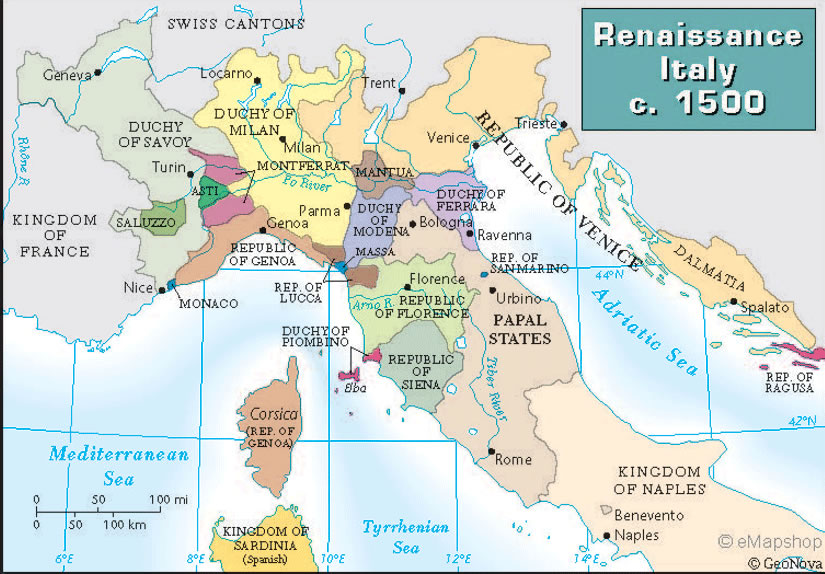
- Florence
- Why Florence? Why Italy?
Humanism Origins
- Francesca Petraca or Petrarch (1304-1374)
- What did he have to say?

Spread of Humanism
Late-14th- and 15th-century Italy
Humanism fit the times: rise of republics

Spread of Humanism
Late-14th- and 15th-century Italy
Humanism fit the times: rise of republics
Growth in Law Schools

Spread of Humanism Beyond the Alps
Italian Law Schools
Example: University of Padua
Bureaucrats (kind of) in Royal Courts
Jesuit Schools


Humanism: Implications
- Humanism vs Scholasticism
- Rejection of Realism
- Lorenzo Valla (1407-1457) and the Donation of Constantine
- Religious Humanism (Erasmus, 1466-1536)
Humanism Implications, Part II: Art
Medieval Art and Realism
Renaissance Art and Nominalism


Next Week:
- The Broader Renaissance