The Renaissance

Part I

First, Some Vocabulary

Country

Government

State

Nation

The actual land or territory controlled by a government

The apparatus or organization that defends and establishes laws over that territory and its inhabitants

The bureaucracy in charge of implementing the laws and policies of the government

The people who identify collectively with one another.

The Medieval World

  • Small states

Map of Europe in 1450

The Medieval World

Feudal Bonds

Image of Feudal Relationships.

The Medieval World

Orders of society:

  1. Church,
  2. Nobility,
  3. Everyone else.

Image of 3 classes of Medieval society: Nobility, Clergy, and commoners

The Medieval World, the University, and the Monastery

Early Medieval Society (500-1000) = Monastery

High Middle Ages (1000-1250) = University

Feudal Elites

Monasteries as collectors and reproducers of knowledge and its production

Universities became the central location of knowledge production: theology, philosophy, and metaphysics (first causes)

Provincial, land-based lords

Medieval Scholasticism

  • The pinnacle of university education.
  • Merging Aristotelian Logic with Biblical Theology
  • By 13th century, much Aristotelianism from Islamic World
  • Method: Proof based system, using decontextualized truth nuggets

What Was the Renaissance?

What do you think the Renaissance was?

Image of figure leaning against question mark.

What Was the Renaissance?

Humanism and the Old Definition

The Civilization of the Renaissance in Italy by Jacob Burckhardt.

Humanism

Based on the Reading What was it not?

What it is:

  • Studia Humanitatis:
    • Grammar
    • Poetry
    • Rhetoric
    • History
    • Moral philosophy

Humanism Origins

  • Florence
  • Why Florence? Why Italy?

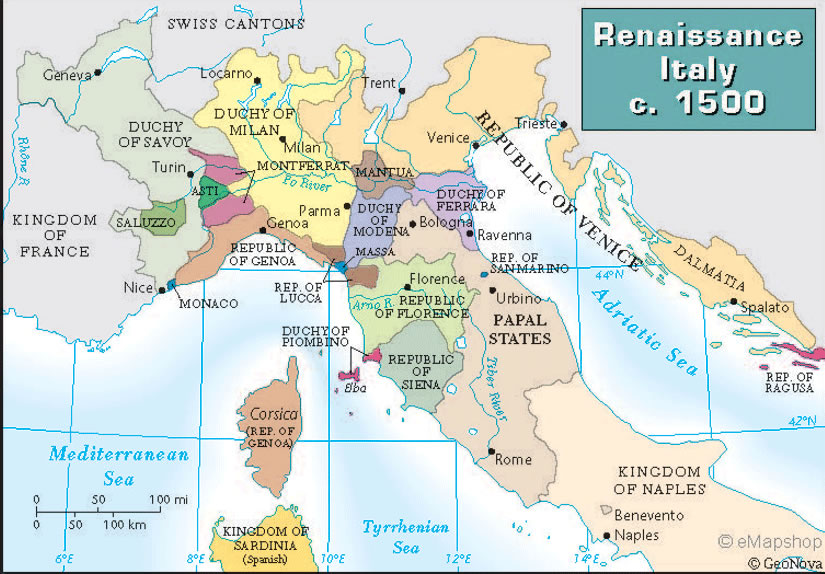
Map of Italy in 1500

Humanism Origins

  • Francesca Petraca or Petrarch (1304-1374)
  • What did he have to say?

Petrarch

Spread of Humanism

Late-14th- and 15th-century Italy

Humanism fit the times: rise of republics

Image of Italian city-states in 15th century

Spread of Humanism

Late-14th- and 15th-century Italy

Humanism fit the times: rise of republics

Growth in Law Schools

Image of building with School of Law emblazoned on it

Spread of Humanism Beyond the Alps

Italian Law Schools

Example: University of Padua

Bureaucrats (kind of) in Royal Courts

Jesuit Schools

Image of Law School

Image of University of Padua

Cartoon image of Bureaucrats around a desk

Image of Society of Jesus Emblem

Humanism: Implications

  • Humanism vs Scholasticism
  • Rejection of Realism
  • Lorenzo Valla (1407-1457) and the Donation of Constantine
  • Religious Humanism (Erasmus, 1466-1536)

Humanism Implications, Part II: Art

Medieval Art and Realism

Renaissance Art and Nominalism

Mary Magdalen announcing the Resurrection to the Apostles, St Albans Psalter, English, 1120–1145.

The School of Athens. by Raphael

Next Week:

  • The Broader Renaissance