1848 Revolutions
- What were they?
- Where were they?
1848 Revolutions
- Revolutions against Absolutist Monarchies
- Revolution for Constitutions
- Revolution for freedom of Press and Demonstration
Causes, Part I: Congress of Vienna
- Weak French Monarchy
- Absolutist Monarchies
- Multi-ethnic Empires
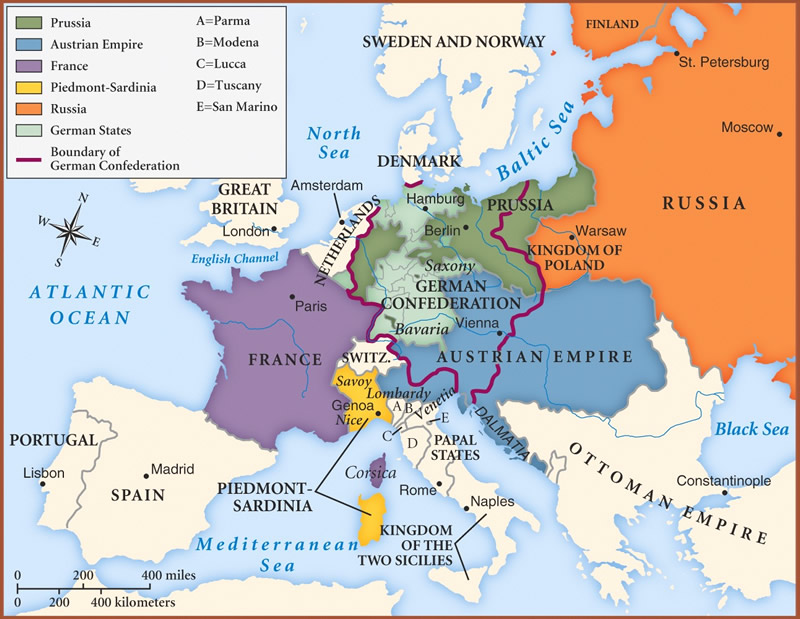
- Congress of Vienna 1815
- Created weak French monarchy
- Italy into dominion of Austria
- Venice = part of Austria
- Lombardy = part of Austria
- Poland to Russia
- Germany broken into German confederation of 39 states
- Generally under dominion of Austrian Empire.
- Ignored liberalism and nationalism.
- Created absolutist states on the basis of pre-French Revolutionary systems
- Absolutist regimes
- Some parliaments with little power.
Causes, Part II: Nationalism
German Confederation & Nationalism
Italian Nationalism
Austrian Empire
- Nationalism
Causes, Part III: Political Activism
- Growth in Reading public
- Growth in political clubs
- Demands for liberal freedoms: Press, demonstration, etc.
- Much to complain about.
- Political Activism
- Expansion of public sphere
- more educated people in 1848 than were in 1800.
- oppressive censorship
- oppression of public assembly
- 1830s-1840s absolutist systems are faltering
- demanding liberal reforms:
- freedom of the press
- Creating political clubs
- Some were moderate, based on
- demanding liberal reforms:
Causes, Part IV: The Hungry Forties
- Industrial City life in Europe
- Real wages dropping in 1830s and 1840s.
- Economic downturn in 1842
- Bad Harvests in 1845 & 1846: Potatoes and Wheat
1848 Revolutions: France in the Beginning
King Louis-Philippe I (r. 1830-1848)
Banquet against Chief Minister François Guizot (22 Feb. 1848)
2nd Republic (24 Feb. 1848-1852)
June Days 1848

- 12 January 1848
- France
- Banquet against Francois Guizot on 22 Feb 1848
- Guizot was the Prime Minister of France and a conservative liberal.
- Defender of limited suffrage.
- To those that wanted the vote, he said, “Enrichissez-vous” (Get rich)
- Cancelled public political meetings known as banquets.
- Many of the banquets were calling for an expansion of the franchise.
- This one was critical Guizot and his government.
- Many get angry and begin to protest.
- 23 Feb 1848, soldiers fire into crowds
- Many of the working class immediately join in
- Overnight fears of massacre from soldiers
- Over million paving stones, 4,000 trees, and 1500 barricades were constructed
- Guizot was the Prime Minister of France and a conservative liberal.
- Louis-Philippe I (1830-1848) fleas to England.
- Banquet against Francois Guizot on 22 Feb 1848
- Organize elections for 2nd republic. (1848-1852)
- Elect new national assembly in April 1848
- Turned into a class based voting
- Liberals were joined by conservative peasants (most of society)
- Didn’t want the monarchy, but didn’t want any social changes.
- Monarchists and conservative republicans got majorities.
- Liberals were joined by conservative peasants (most of society)
- Paris radicals refused to Accept the results
- Led to conflict between he liberal property owners and the urban poor.
- June Days
- the conflict turned violent
- The industrial workers of Paris launched another revolt against the liberal government.
- Fighters were the industrial workers (masons, locksmith, etc.)
- Many of the propertied classes (peasants shopkeepers, landowners)
- Flowed into Paris to stop the fighting.
- 3,000 rebels were shot
- 12,000 arrested.
- 4,500 deported.
- Socialist clubs and newspapers were shuttered.
1848 Revolution: France Fails
President Louis-Napoleon Bonaparte (Dec. 1848-1852)
President for Life
Emperor Napoleon III (r. 1852-1870)
- Presidential elections
- Louis-Napoleon Bonaparte (1808-1873)
- was elected president
- sold himself as protector of property and protector of voting rights.
- then suppressed institutions of liberal political culture.
- radical clubs abolished
- 1850, removed universal male suffrage.
- Dec. 1851, declared self president for life.
- abolished the legislature.
- 1852, declared self emperor napoleon III.
- Louis-Napoleon Bonaparte (1808-1873)
1848 Revolutions: Italy in the Beginning
Palermo, 12 January 1848
Sought a Constitution and lower Taxes
Constintutional Monarchies
- Italy
- Began 12 Jan 1848 in Palermo
- Spread to Naples
- Quickly Kingdom of two Sicilies (Naples) granted constitution and basic civil liberties.
- In Feb. Grand Duchy of Tuscany granted constitution.
- After news of Paris came more fell
- Pope Pius IX (the liberal pope) granted constitutional monarchy
- Piedmont-Sardinia also granted constitutional monarchy.
- Then Lombardy declared itself independent from Austria
- Then Venice declared itself independent of Austria.
- These led to war with Austria
- Led to revolt in the countryside,
- Especially over usage of the forests (think of it like the killing of the pigeons).
1848 Revolutions: Italy Fails
Lombardy and Venetia declare independence
King Carlo-Alberto (Piedmont-Sardinia), in 1848
Austria Crushes the Italian Revolutions
Louis-Napoleon Bonaparte (1849)
- Failure
- The king of Piedmont-Sardinia Carlo-Alberto overplayed hand
- Led plebiscite votes where Lombardy and Venice voted to join Piedmont-Sardinia
- Split the nationalists in Italy.
- Led the central powers of Italy to withdraw support for the war.
- Piedmont-Sardinia could not defeat the Austrians alone.
- Austria destroyed the
- Radicals then took control of Rome,
- Hoping to spur unification.
- But Louis-Napoleon was invited to intervene by the Catholic clergy and forced their surrender of the Republicans
1848 Revolutions: German Lands
King Friedrich Wilhelm IV (r. 1840-1861)
Grants Constitutional Monarchy and legislative assembly
German Confederation elects him King of unified Germany, March 1849
A crown from the gutter

- Prussia
- Freidrich-Wilhelm IV accepted changes early on
- Really regretted accepting them
- inspired many liberals at the German Confederation to put hope in him
- starting creating a new consitution for a united Germany.
- created a mixture of the USA system and the parliamentary system of UK.
- Then Friedrich-Wilhelm changed his mind.
- Dec. 1848 new legislature took its seats.
- One week later, he formed a new government around a conservative prime minister
- marched an army into Berlin
- dissolved parliament
- rewrote a new more conservative constitution.
1848 Revolutions: Austria Fails
Nationalist Revolutions
Vienna, Prague, Lombardy, Venetia, Zagreb (Croatia)
Revolutionary in-fighting
Military Repression
- Austria
- Nationalist revolutions
- in Vienna, Prague, Lombardy, Venetia, Zagreb (Croatia)
- all declaring soverign authority
- all wanted end of Klemens von Metternich (foreign minister 1809-1821, Chancellor 1821-1848)
- he stepped down.
- march 12,
- Czech Natioanlists calling for a Czech national assembly within Austria
- Hungary won autonomy, a parliament and an elected legislature.
- they were granted.
- They ran into major problems
- class problems
- Peasants vs Austrians
- peasants vs local nobles
- national problems
- multiple nations within areas
- Germans supported the crush of the Czechs in Prague
- they supported national sovereignty but thought Czechs threatened their own.
- multiple nations within areas
- class problems
- led to a series of devastating defeats against Austrian Armies in 1848.
- Refused the concessions already made to Hungary for example by having Ferdinand I abdicate the throne in favor of Franz Josef.
- Hungarians fought on
- Russia then granted support to Austria.
- Hungary finally subjugated in August 1849.
- in Vienna, Prague, Lombardy, Venetia, Zagreb (Croatia)
- Nationalist revolutions
Consequences
- Newspapers
- Political Clubs
- Class & Political Divisions
- Nationalism
- Consequences.
- newspapers
- Austria
- before 1848
- 79 newspapers, 19 discussed politics
- after
- 388 papers, 306 were political news.
- before 1848
- Austria
- political clubs
- German-speaking Europe
- between 1 million and 1.5 million people joined political clubs.
- 1 out of every 9-10 men.
- between 1 million and 1.5 million people joined political clubs.
- clubs turned people into citizens
- in Germany they became really important to conservative politics
- by 1849, conservative clubs outnumbered liberal clubs.
- in Germany they became really important to conservative politics
- German-speaking Europe
- Created large political meetings
- planned well ahead of time and publicized.
- women joined these meetings
- other times women joined political clubs.
- they became increasingly participatory.
- Class & political division
- became clear that there were major divisions between class and poltiics
- newspapers