The Estates General: Called in Jan. 1789
- Plans: Vast Institutional Reform
- Cahier des Doléances
- Decision would be binding
- Problems:
- Politicized the whole country
- Last Estates General, 1614
- “What is the Third Estate?” (Jan. 1789)
- by Abbé Emmanuel Joseph Sieyès
- Plans:
- Cahier des Doléances: List of grievances from each estate
- Requested that all communities draw a list of grievances the communities had (Louis asks). What they want to be changed.
- Decision would be binding: The Estates General would have the power to make decisions for the reform of the country.
- Cahier des Doléances: List of grievances from each estate
- Problems:
- Politicized the whole country: This told the whole country to think about their problems and how to fix them.
- Suddenly everyone has the right to say what is on their mind (he doesn’t realize this)
- Suddenly everyone has the right to say what is on their mind (he doesn’t realize this)
- Last Estates General, 1614:
- No institutional memory of how to run an Estates General.
- Fear that the Nobility and the Clergy would team up against the Third Estate (everyone else)
- What is the Third Estate? by Abbé Emmanuel Joseph Sieyès:
- Pamphlet that argued that the Third Estate was the true representative of the nation and should have more power in the Estates General.
- Politicized the whole country: This told the whole country to think about their problems and how to fix them.
The Estates General: Meets in May 1789 at Versailles
- How to Vote
- A Failed compromise by Louis XVI
- 3rd estate: the National Assembly (June 17, 1789)
- How to Vote
- Last time each estate got 1 vote.
- Problem with representation.
- 1 (clergy) = 136,000 people.
- 2 (nobility) = 1-2% of population.
- 3 (everyone else) = 98% of population.
- Also, most clergy came from noble families.
- Third estate has twice as many representatives as other two estates.
- A Failed compromise by Louis XVI
- Vote by order/estate.
- Each estate gets 1 vote.
- Third estate gets 2 votes.
- 3rd estate: the National Assembly (June 17, 1789)
- Bad compromise.
- It politicized and angered the third estate.
- The third estate comes together and establishes itself as that National Assembly.
- It speaks for the nation.
- To not join is to not speak for the nation.
- Louis XVI drags his feet. He doesn’t know what to do.
The Tennis Court Oath (20 June 1789):
A Misunderstanding
The Tennis Court Oath: Constitutional Monarchy
Significance
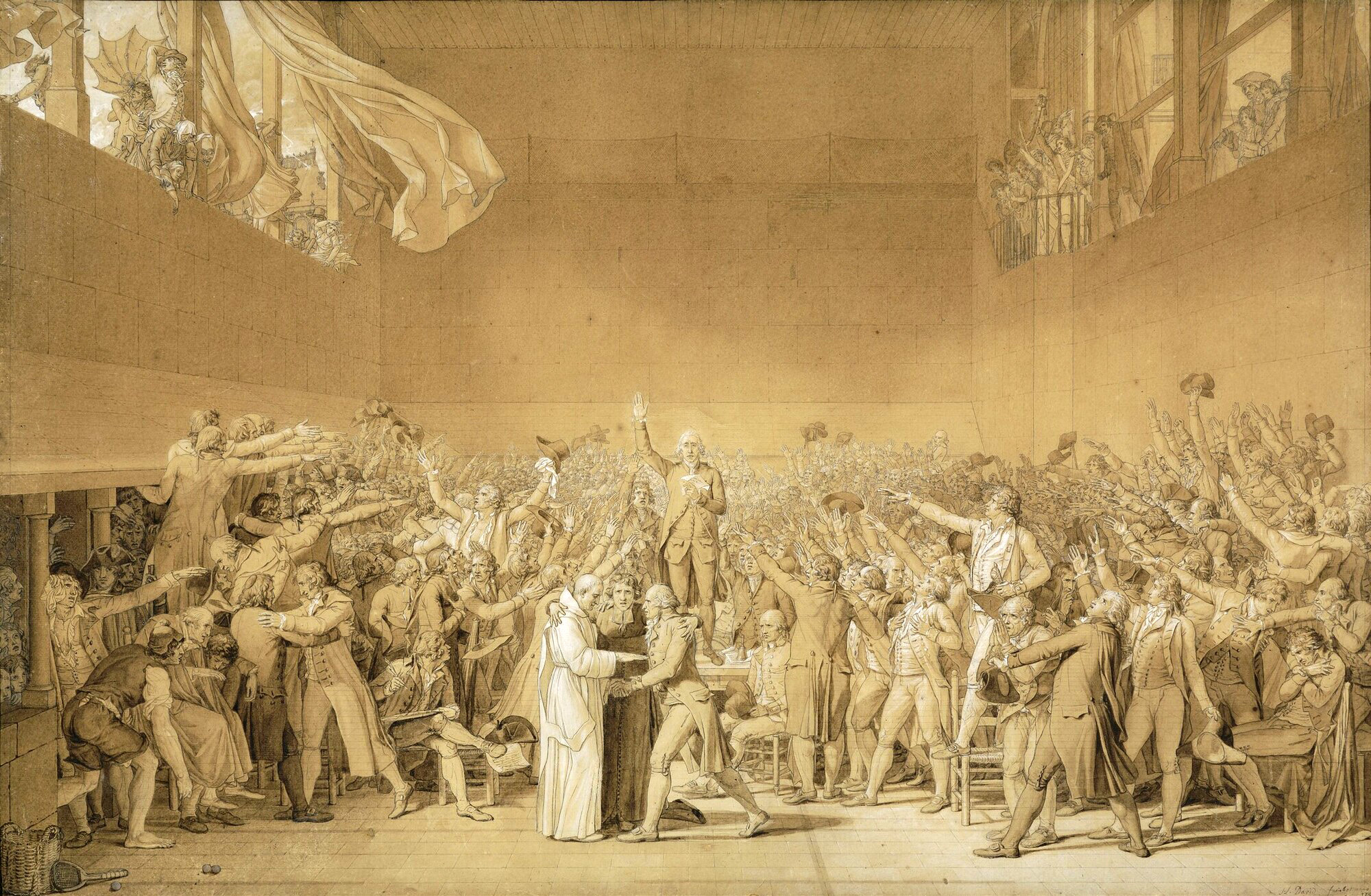
- A Misunderstanding:
- Accidentally locked out of hall.
- The Tennis Court Oath: Constitutional Monarchy:
- Oath not to disband until they wrote a constitution for France.
- Says we are not going back.
- Significance:
- This is the moment revolution begins.
- Complete overthrow of power.
- New definition of state/society:
- No longer a society with distinct privileges.
- Now common nation under monarch with theoretical equality between members.
- This is the superpower of the western world at the moment.
- They are absolutely overturning the apple cart.
New Conceptions of State and Society
- The Nation
- High Revolution vs Popular Revolution
- High Tensions in Paris
- Storming of the Bastille, 14 July 1789
- The Nation:
- The invention and implementation of the nation.
- No longer disconnected subjects. They are a nation under a king. but this will change.
- Leads to new understanding of liberty.
- Liberty is universal, from individual groups to everyone.
- High Rev. Vs Popular Rev.:
- Revolution will take place in two different ways.
- High revolution: those making decisions and writing in news papers, etc.
- Popular violence.
- Revolution will take place in two different ways.
- High Tensions in Paris:
- The National Assembly was under threat of the powers that be overthrowing the experiment.
- Mid-July, the people of Paris rose up.
- Storming of the Bastille:
- The Bastille was a prison and armory.
- It was a symbol of the monarchy’s power.
- The people of Paris stormed it and took it over.
- This is the moment that the revolution becomes violent.
- Army didn’t react.
- Popular violence makes statement that the people of paris want the assembly to continue.
- Government lost control over the military force.
- New military force created: National Guard.
- Tried to hold on to power.
- Forms a new internal military police force.
- Marquis de LaFayette placed in charge.
New Conceptions of State and Society
Aug. 4, 1789: National Assembly eliminates social privileges
Declarations of Rights of Man and Citizen (1789)
Women’s March, October 1789
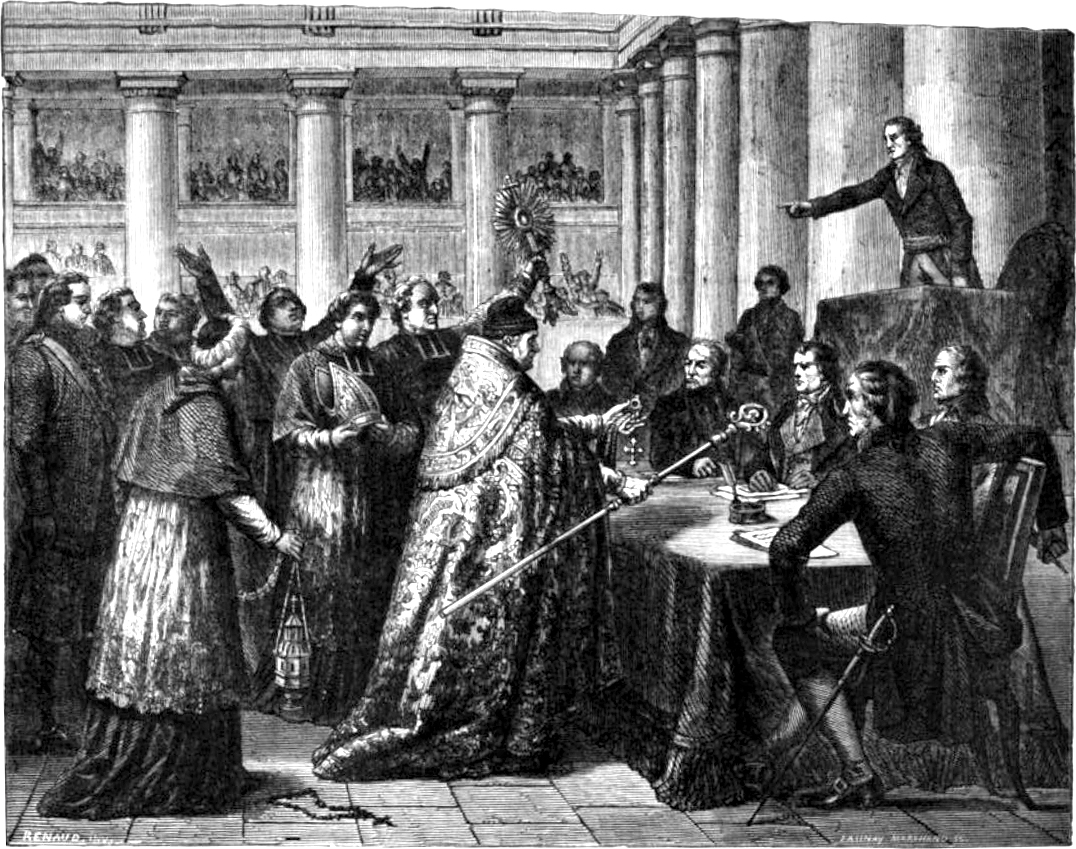
Civil Constitution of the Clergy (1790)
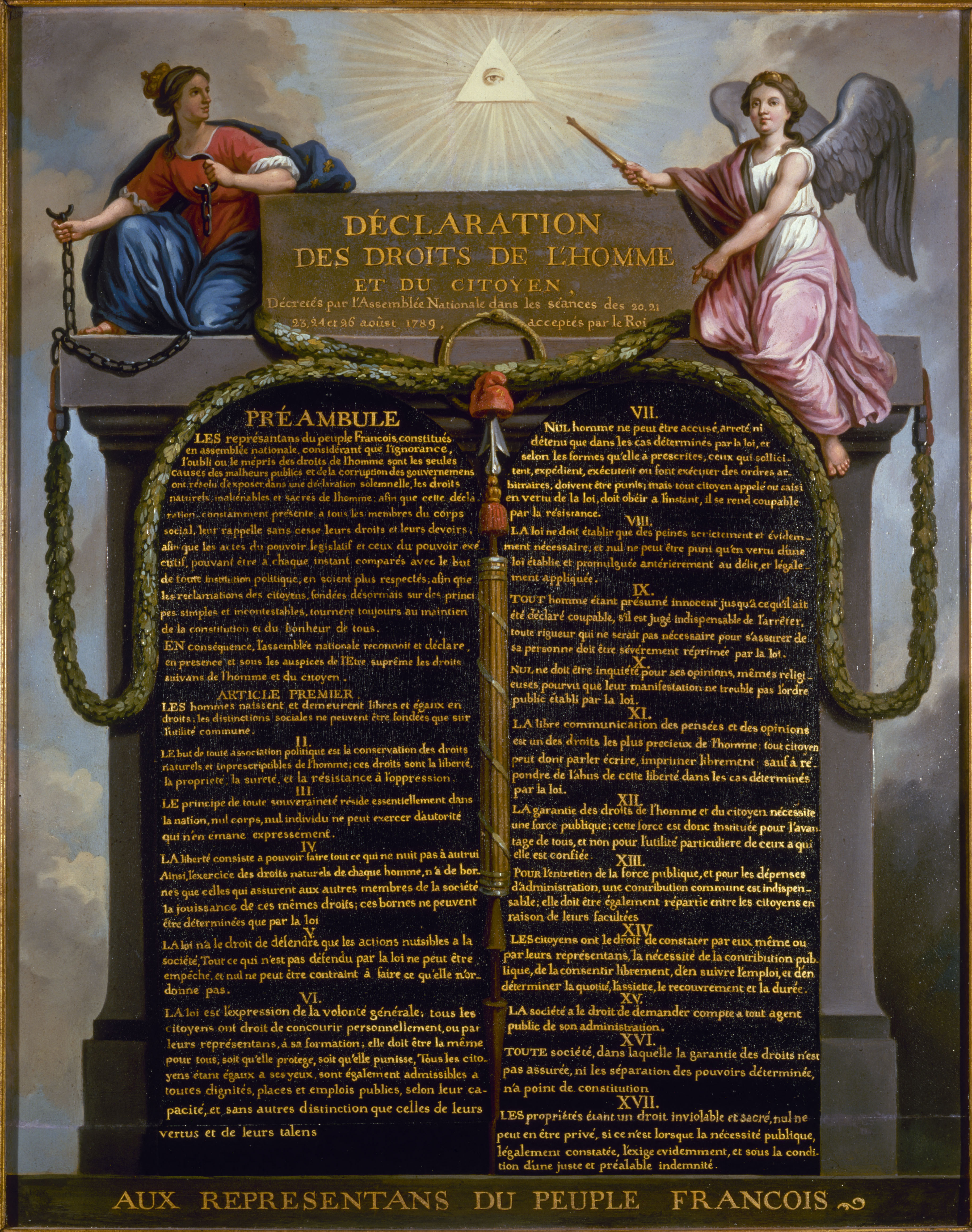

- Aug. 4, 1789: National Assembly eliminates social privileges:
- The National Assembly abolished the feudal system and the privileges of the nobility and clergy.
- This was a major step towards equality and the end of the old regime.
- Women’s March (5 Oct. 1789):
- Began in marketplace of Paris.
- Angry over the price of bread.
- March to Versailles break in attack soldiers and Louis XVI and his family forced to return to Paris.
- Civil Constitution of the Clergy (1790):
- The National Assembly passed a law that required all clergy to swear an oath of loyalty to the state.
- This was a major change in the relationship between the church and the state.
Failed Consensus (1790-1791)
- Noble Emigrés
- Flight to Varennes (June 1791)
- Constitutional Monarchy Declared: Legislative Assembly (Oct. 1791)
- April 1792, War against Prussia and Austria
- Noble Emigrés:
- Nobles who fled France and were plotting to overthrow the revolution.
- Begin negotiating with the Hapsburgs.
- HRE is the brother in law to the king.
- Flight to Varennes (June 1791):
- Louis XVI and his family attempted to flee France.
- They were caught and returned to Paris.
- They claimed they were kidnapped.
- Constitutional Monarchy Declared: Legislative Assembly (Oct. 1791):
- The National Assembly wrote a constitution that created a constitutional monarchy.
- The Legislative Assembly was the new governing body.
- Begins to push more and more for war.
- The solution to the problems will be military.
- Some think this will bring unity to the state.
- King and Queen go along with it.
- Betting on France losing
- If France loses, monarchs will end on top.
The Radical Revolution (1792-1794)
- Universal Revolution & Military Setbacks
- Bunswick Manefesto (July 1792)
- The National Convention (Sept. 1792)
- Universal Male suffrage
- Universal Revolution
- Thought of the war as universal.
- Must be brought to everybody.
- Once French show up, the people will rise up and accept them.
- Military setbacks:
- Fr. Doesn’t do well.
- In part b/c the army was aristocratic and many of the officers fled country.
- Huge upheaval of ranks
- If people are equal the army shouldn’t have superiors and inferiors, that isn’t equality.
- Orders that don’t make sense don’t have
- Companies voting not to go on attack, etc.
- Issues of supply
- Issues of training
- Fr. Doesn’t do well.
- The Brunswick Manifesto (July ’92)
- Says if Fr. Harms the monarchy they would destroy France and destroy the revolution
- Helps promote the notion of fighting for universal
- Storming the Tuilleries (Aug. ’92)
- The royal palace is stormed by mob and King/Queen put under arrest.
- ’92 Fr. Declares republic to be born.
- Proclamation of the Republic (22 sept 92)
- Created national convention
- Universal male suffrage.
- French open everything
- Radical step.
The Reign of Terror (1793-1794): Part I
Trial & Execution of Louis XVI (Jan. 1793)
Foreign Invasions
Civil War: The Vendée (1793-1794)


- Issues about how to govern
- Civil wars erupt.
- Huge multi-faceted situation.
- Decide that a king is threat to Republic (king must dies)
- By one vote in favor, FR. Gov’t decides to execute Louis XVI on grounds of treason.
- He was a king, he was a traitor to republic.
- Some voted to exile him to America, but he is voted to be executed.
- Executed by guillotine in ornate fashion in Paris.
- Much faster than previous methods (progressive method).
- The national convention
- The crises of 1793
- Foreign invasions
- Civil wars
- Gov’t by terror.
- Gov’t being attacked outside and inside.
- Gov’t has right to defend itself and defend equality.
- Decides to put emergency executive powers into committee
The Reign of Terror (1793-1794): Part II
- The Committee of Public Safety & Maximilien Robespierre
- Military Reforms: Levée en masse & shock tactics
- 1794: Military Success
- Revolutionary Changes:
- Republican Calendar (1793-1805)
- Cult of Reason & Cult of Supreme Being
- Committee of Public Safety (Robespierre—1758-94)
- Given executive power
- 12 men
- Mouth piece is Robespierre (not a dictator)
- Had to be voted on by National assembly.
- Begins to use capitol punishment greatly and is voted on by national assembly by universal mass suffrage.
- Many harsh decrees
- Over course of year several thousands imprisoned
- Given executive power
- Military Reforms
- Brings in first round of national conscription
- Demands what
- Everything directed to survival of republic itself
- All potential directed
- Institutes new tactics:
- Didn’t have time to drill.
- Will reassert military discipline but will never be same a Prussian
- Separation between officers and others not as strict.
- Can’t do wonderful maneuvers and institutes ideas of shock tactics.
- Centered around many men on battlefield and just overwhelm the enemy.
- Must accept high casualties.
- Institutes mobility
- Breaks army into different corpes (can help each other or work alone)
- Introduces armies living off land again
- Will forage.
- No more supply depots.
- Levee en masse
- Mass rising
- Men of adult age is open to conscription.
- Has civilian side to it
- Takes the entire economy of country and directs it to war effort.
The End of the Terror
Robespierre to the Guillatine, July 1794
Begin drafting New constitution, July 1794

- 1794, Military successes.
- Robespierre is executed by guillotine.