Main Argument
- Colonial agriculture based on sugar worked by millions of enslaved Africans caused an economic transformation in Europe and the Americas that was a necessary pre-condition for the enlightenment, the age of revolutions.
- Necessary here does not mean good. But without which the enlightenment and revolutions would not have been possible at least not in the way they happened.
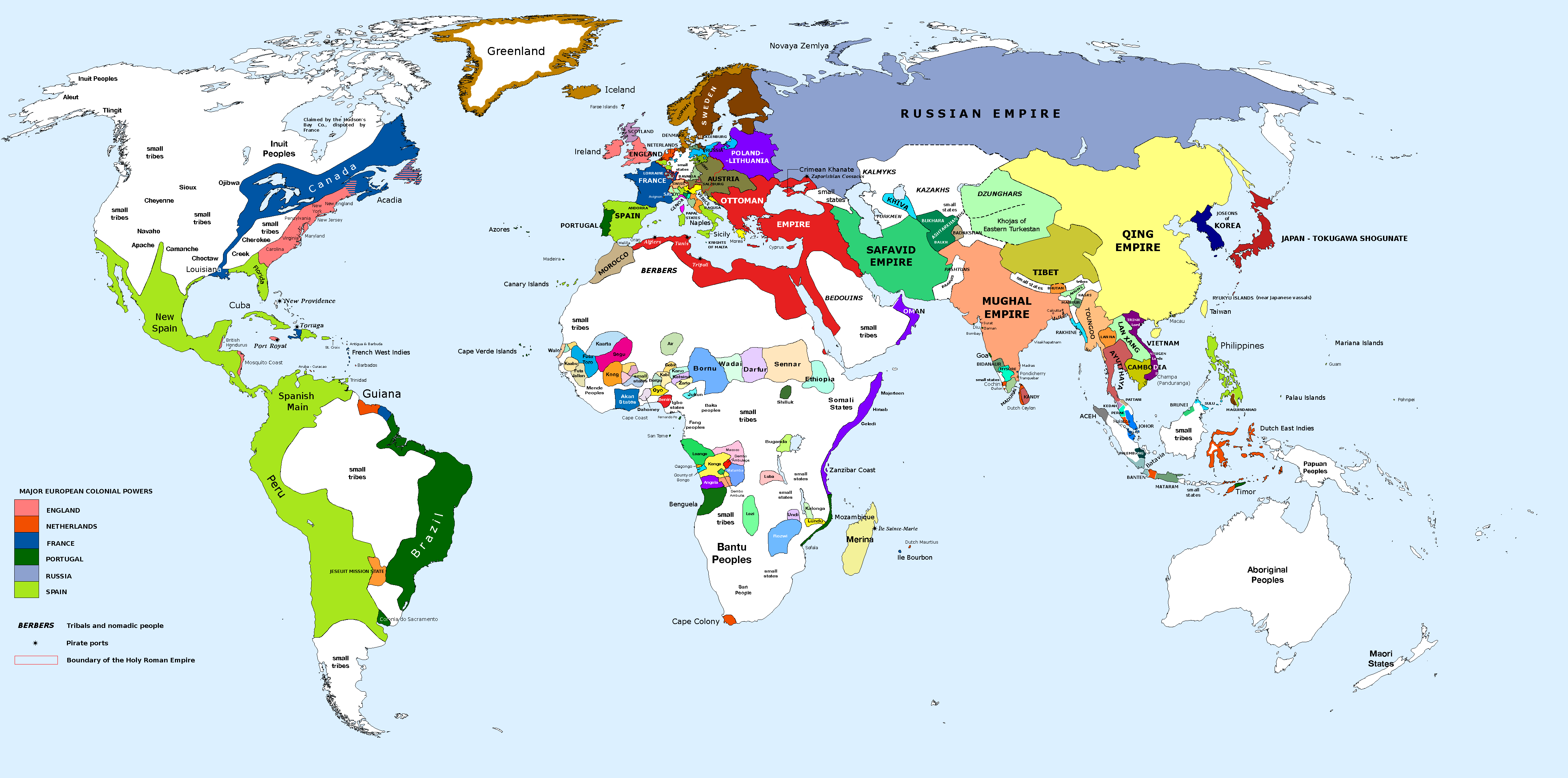
European Colonies in 1725
Early European Slavery
- Portuguese Slave Trade & Brazil
- Slavery in Africa
- Expansions of Slavery from Caribbean
- Impact on Africa
- Portuguese Slave Trade & Brazil
- Portuguese colonies in W. Africa
- grew sugar cane , cotton,, etc.
- Europeans looked to Africa for enslaved people
- Portuguese colonies in W. Africa
- Slavery in Africa
- in Africa, slavery looked different
- Serfs-like position, some were part of family (could even own property and buy freedom), others indentured servants.
- White Europeans came **to buy Africans, with rum, guns, and silver.
- Africans thought about those they sold as debtors, prisoners of war, or criminals.
- By selling them, kings strengthened themselves and grew stronger by trade with the Europeans.
- in Africa, slavery looked different
- Expansions of Slavery from Caribbean
- Sugar plantations in Caribbean
- 50% of all enslaved people transported to Caribbean.
- 5% of all enslaved people transported to North America.
- Impact on Africa
- Capturing slaves became a motivation for war, not a result.
- Competitors needed arms to fight their neighbors, they began selling slaves to compete.
- It became an arms race driven by the Atlantic slave trade.
- Created a demographic crisis
- lost 10s of millions
- created long-term demographic impact
- When slave trade outlawed, many kingdom’s economies, dependent on the slave trade, collapsed, which left them open to conquest after 1807.
- Increased competition ans weapons fueled warfare
- developed racist ideology
- Europeans needed justification for enslavement
- Claimed Africans were biologically inferior.
- Capturing slaves became a motivation for war, not a result.
Slavery in the Caribbean: Scale
- Where did most enslaved Africans go?
- Sugar became the oil of the Atlantic economy.
- Production Process
- Where did most enslaved Africans go?
- Slavery was the basis for all this wealth
- Africans became the bulk of labor force.
- Haiti, whites outnumber 10-20 to 1.
- process:
- cut the cane
- mille the cane
- boil the cane to separate molassas from sugar
- then separate impurities from brown sugar.
- molassas was used to make rum.
- sugar plantations employed 100-200 enslaved africans
- 1/2 on sugar cane, other half on processing.
- more like factories than farms.
Slavery in Caribbean: Treatment
- Code Noire (1685) in Theory?
- Code Noire (1685) in Practice?
- Nicholas Le Jeune (1788)
- Where did most enslaved Africans go?
- Code Noire (1685) in Theory?
- Article 1 banned Jews from colonies.
- Other laws might not be too bad
- Torture was legal for whites in France
- Code Noire (1685) in Practice?
- But look at the implementations of the law in the Caribbean
- disconnect between the two
- registers of the plantations
- Conditions for slaves was much worse than the code noire
- masters killed slaves in colonies (not supposed to)
- Did not feed/clothe their slaves properly
- They had sex with slaves.
- Slave was supposed to complain about master for breaking code to magistrate
- But slave could not testify against the master.
- Courts biased toward the planters.
- But look at the implementations of the law in the Caribbean
- Nicholas Le Jeune (1788)
- 1788: French planter Nicolas le Jeune
- Thought slaves wanted to poison them
- he tortured them
- some slaves complained to courts
- Prosecutor stumbled on women shackled in a cell with limbs burnt off. Some died
- Le jeune did not dispute it.
- Basis of colony was racial inequality, he claimed.
- Rule - white person is always right.
- Rule - if whiter person is wrong, refer to rule 1.
- If the courts ruled against Le Jeune the risk was slaves revolting.
- 1788: French planter Nicolas le Jeune
Agency of Enslaved People?
- Agency of Enslaved People
- Strategies of resistance
- mixed-race children
- Toussaint Louverture grew up on slave plantation
- one way of survival: accomodate
- Louverture was a creole (born in caribbean).
- Louverture able to work with oxen
- If work well enough can turn it into his manumission.
- Louverture gained his freedom.
- Louverture’s daughter had a mixed-race child.
- Was she raped?
- Was it a strategy of accommodation?
- A way of gaining some advantages it.
- Comparison to Sally Hemmings.
- strategy of confrontation
- many slaves committed suicid- Idea of being reincarnated in the world of their ancestors back in Africa.
- death rate of children was high
- poor treatment
- many masters thought it was female infanticide.
- mother’s resisting their fate by denying thier children the suffering of their masters.
- some ran away in the hills until they got what they wanted
- (strike) or marroonage
- do it in time to endanger the harvest
- it could work and they could get what they wanted.
- run away for a few days to protest
- others tried to run away for good.
- MacKendo: was one of these runaways
- tortured then burnt at the stake in 1758.
- escaped the fire, then they threw them back on it.
- many slaves did not see this, so slaves continued to see Mackendo to come back and save them.
- revolt
- many slave revolts
- every revolt failed
- except the one in saint domingue.
- all troops that were sent to put it down suffered from
Sugar and the Atlantic Slave Economy
- More than the Triangular Trade
- Sugar and Slavery, fundamental to 18c economy
- Economies dependent on Slave Societies
- While this was clear in the Caribbean as you saw in the videos and podcasts on Caribbean slavery and the Haitian revolution, it was also the case in the American colonies
- The colonies were especially dependent on tobacco as a cash crop worked by slave labo- Sugar did not grow well, and cotton was not productive until the cotton engine was invented.
- But even beyond tobacco, the American colonies tremendously benefitted from the Atlantic sugar trade
- The various states/colonies of the Atlantic benefitted from this dramatic increase in trade
- Nothing was wasted (except the lives of Africans).
- Sugar was traded to the Americas and Europe, but the molasses that is a raw biproduct of the sugar process was traded to North America to produce rum
- Rum became the most profitable manufactured item in New England.
- Northern women subsidized their families’ income by sewing frocks for merchants who sold them to slaves across the colonies.
- Sugar was traded to the Americas and Europe, but the molasses that is a raw biproduct of the sugar process was traded to North America to produce rum
- Port cities were transformed by the slave economy.
- Flax, hemp, and cotton producers creating textiles for shipping.
- Rope makers.
- Barrel makers.
- Sail riggers.
- Ship builders.
Broader Dependence on Slave Economy
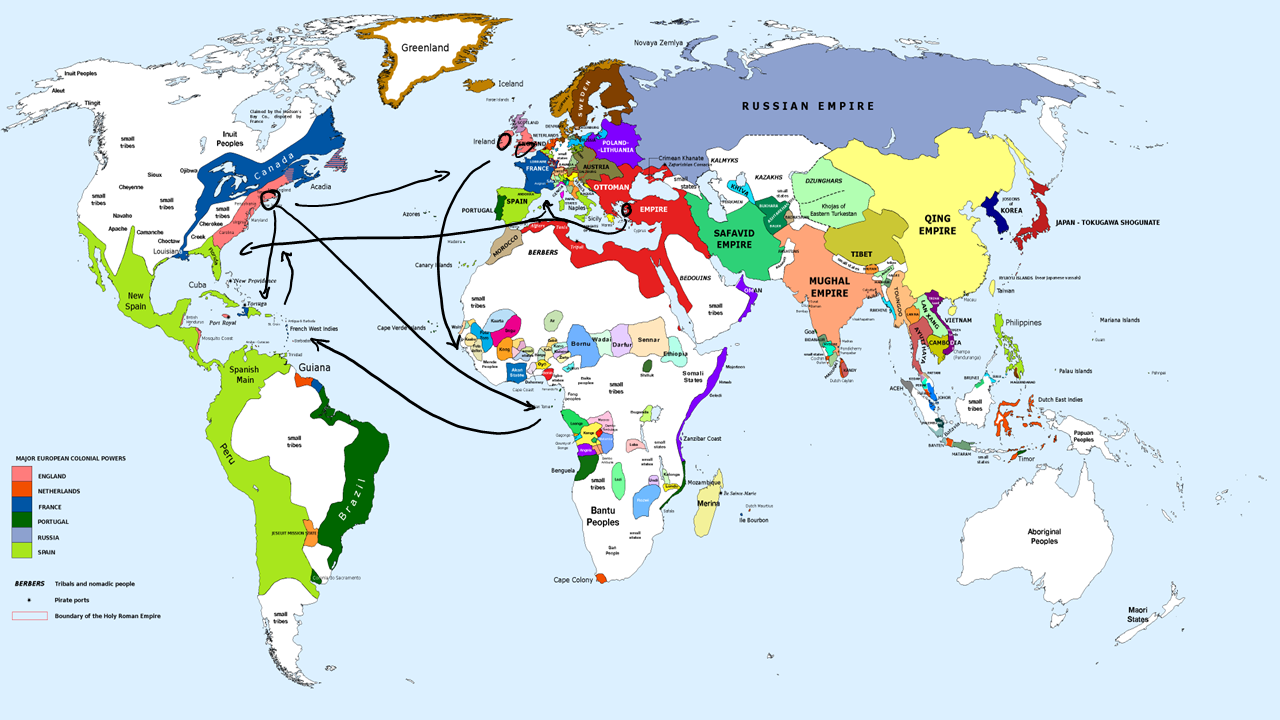
- But the connections between these trades were even more immense. We can see how entangled this economy was by looking at those connections to how slaves in the Caribbean were sustained by products from around the Atlantic
- A slave in the Caribbean might be purchased with linens woven in Silesia (eastern Austria) or copper bars smelted in wales, or Rum distilled in Rhode Islan- The slaves might eat salted beef from Ireland. They might have worn textiles from New England. They might have worked at night under candles rolled in Nantucket.
- We can draw these connections out further:
- The textiles made in New England for a slave in the Caribbean likely came from wool that came from Argentina or Izmir. The wool might have been cleaned at the almshouse in New England and dyed red from cochineel from Mexico, woven on looms outfitted with reeds from South Carolina and finished on a mill that used teasils from France.
- This leaves us with a question: where did the reach of slavery end during this period? New England rum distillers, Irish salt beef makers, Mediterranean shepherds, Mexican dye makers, South Carolina reed suppliers were all supported indirectly by the slave economy.
Econ. Growth in Non-Slave Societies
- Increase in Shipping Tonnage
- Bordeaux: 1720 => 1785
- Nantes : 1727 => 1790
- Growth in Port economies
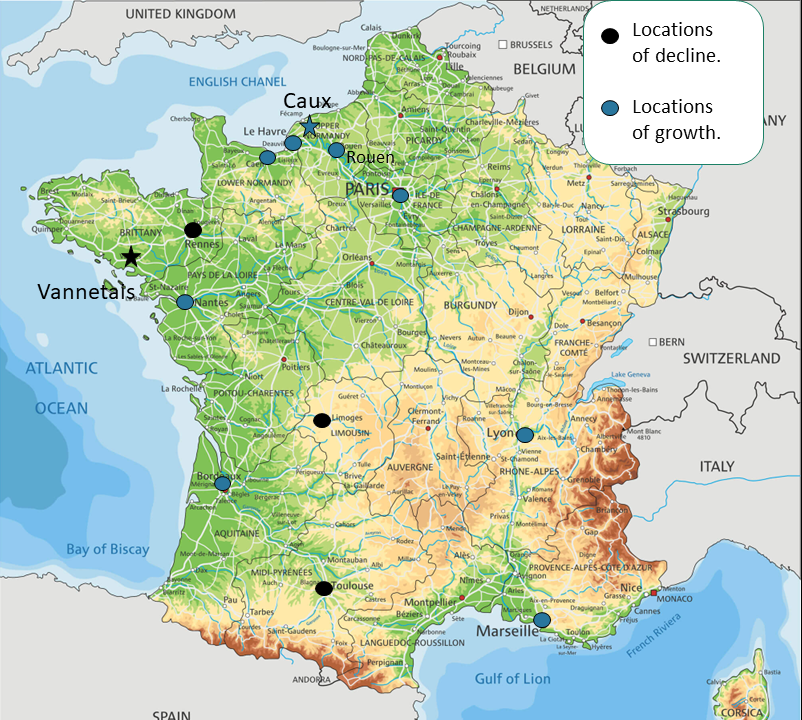
- Even those who were not directly involved in the slave trade benefitted from the economic improvements. Looking at the Atlantic ports of France we can see how impactful the growth of the slave economy was.
- Over the century, shipping tonnage increased dramatically.
- in **Bordeaux*- (a port on French Atlantic) shipping tonnage doubled between 17- and 1785.
- The Average capacity of a ship increased from - tons in 1700 to 112 tons by 1782.
- In Nantes (another port on the French Atlantic), the entire combined capacity of the ships in the port in 17- (16,000 tons) could fit in the hulls of just 34 ships at the port of Nantes in 1790.
- But most of the people in Nantes were not directly connected with the slave trade or with the sugar trade.
- They produced the cloth paper metal and brandy that could be traded for slaves in Africa that were then exchanged for the sugar in the Caribbean, or directly exchanged for the sugar itself in the Caribbean.
- But most of the people in Nantes were not directly connected with the slave trade or with the sugar trade.
- Over the century, shipping tonnage increased dramatically.
Split in Economies
- Growth in Textiles
- Impact on the countryside
- Caux
- Vannetais
- This dramatic increase can be attributed primarily to the growing slave trade and the products slaves produced in the Americas.
- France demonstrates this phenomena well because the French economy essentially spli- The regions and cities connected to the new international system grew economically and demographically.
- Capital accumulated from the slave, sugar, and coffee trade flowed into France’s growing textile trade.**
- It became increasingly fashionable to wear men’s and women’s garments infrequently, always having to buy something new to wear at court, or dinners, or salon-
- The benefits of this growth simillarly extended to the countryside around those burgeoning towns
- In **Caux*- an agricultural region around Rouen (a major atlantic city near many ports),
- For instance, new income from textile weaving allowed peasants to invest more in land development.
- From 1680 to 1789, the number of horses on farms grew 53%; cattle grew 42%.
- For instance, new income from textile weaving allowed peasants to invest more in land development.
- In Avremesnil in the same region, the number of people who owned livestock doubled from 1760 until 1789.
- During the same period, the number of horses and cattle similarly doubled
- But what does this mean? More livestock means more fertilizer, meaning more grain output per acre of land
- But in **Vannetais*- a region of France on the coast but isolated from the major ports,
- no such growth developed.
- Their livestock numbers remained basically the same during the period
- But what does horse and cattle population have to do with the slave economy of the Atlantic world?
- Everything, because it shows how much that economy transformed entire regions while those regions disconnected from that system were left behind.
- In **Caux*- an agricultural region around Rouen (a major atlantic city near many ports),