European Colonies: 1625
- Spain
- Central America
- Peru
- Philippines
- Portugal
- Coast of Brazil
- Trading ports in Africa and Indian Ocean
- France
- Quebec (Population=85)
- England
- Jamestown and Plymouth
- European footprint=relatively small
- Spain
- Central America
- Peru
- Philippines
- some caribbean islands
- Portugal
- The coasts of Brazil
- Trading posts and islands in Indian Ocean and African coasts
- Dutch
- Some trading posts in the Indian Ocean
- New Netherlands (New York, etc.)
- New Netherlands went to English in exchange for Suriname in 1674 after the second dutch war)
- French
- Quebec (pop = 85)
- England
- North Am
- Jamestown
- Plymouth colony
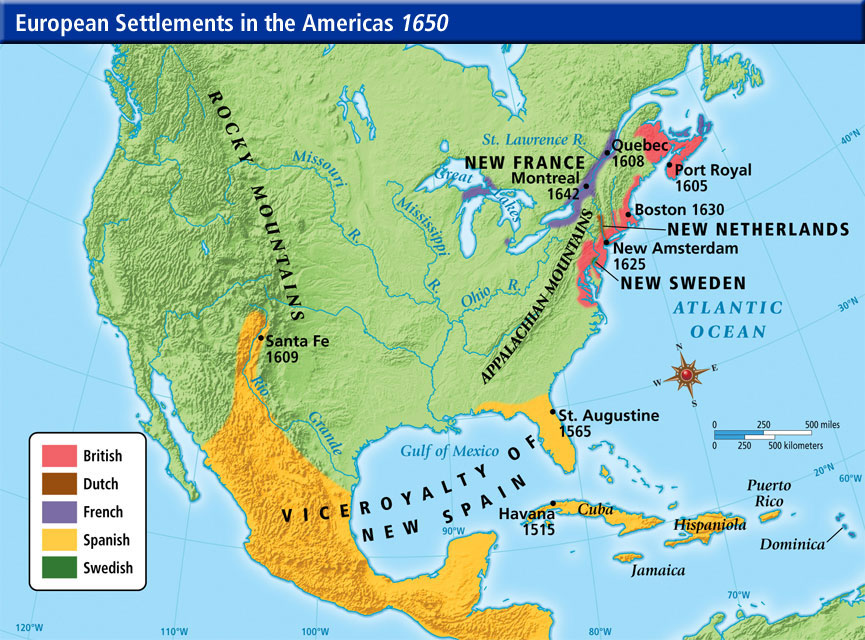
Still Seeking the East: Part I: Small Changes
Jamestown (1607)
Plymouth Colony (1620)
New France (1608)
New Netherlands (1614)


- Searching for access to the East
- England - Jamestown - searching for gold or silver - also looking for river access to the Pacific Ocean
- France
- Searching for a North Sea route to Pacific
- Samuel de Champlain (1609) - traveled through the St. Lawrence river and through the great lakes searching for the Orient.
- These explorations created the basis of French colony of New France - focused on
- England - Religion - Separatists founded Plymouth - then others followed:
First Major Change: Dutch East India Company (VOC), 1602
Dutch in Indian Ocean
Dutch East India Company (VOC)
Jakarta/Batavia (1619)

- By 1600, Dutch were trading in the Indian Ocean with large ships
- Many previously sailed with he Portuguese but went out on their own
- By 1600, they had depressed the market and profits
- Pooled together resources and created the joint-stock company the VOC
- Given monopoly over the trade in Indian Ocean by dutch states
- People bought stock in the entire company
- Supporting all its efforts, not just one voyage
- Spread out the risk
- Company paid out profits to investors based on ownership
- Joint-stock company
- This was the first “joint-stock company”
- received monopoly from dutch
- dutch initially supported it monetarily.
- granted it political sovereignty over territories under its control
- Trading forts from Portugal
- expanded its control in Indian Ocean by conquering trading forts from the Portuguese.
- Jakarta/Batavia (1619)
- took over Jakarta in 1619
- renamed it Batavia
- Became the key trading fort to the VOC. - central command - built a shipyard there - conquered surrounding islands - in bloody battles - often enslaved those who remained - exported them to different locations to work - on sugar plantations or cutting wood/building ships. - started growing sugar plantations there (they inherited them from the Javanese - they were worked by Chinese laborers.
- By 1680s, they created a world-wide monopoly
Motivations and Impacts
Motivation:
- Union of Spain and Portugal (1580-1668)
- Rivalry/War with Spain (1580-1609, 1621-1648)
Impact:
- From Partnerships to Dutch Dominance
- Dependence on Slave Labor
- Transformed the Indian Ocean from one of partnerships between the Portuguese and east-Asian partners that controlled the spice trade
- East-Asian traders became dependent on the Dutch in the spice trade.
- They also became major controllers of the country trade
- Trading silver between Japan and China
- Chinese porcelain to India and Japan
- Indian Opium to china
- Made lots of money as a middleman as they almost monopolized trade.
- Exemplary of this dominance is the number of slaves
- One estimate is that between 1/3 - 2/3 of the population of VOC colonies were enslaved people.
- from South Asia, Africa, and South-East Asia
- worked as domestic laborers, shipping, mining, agriculture, and spice/sugar plantations
- One estimate is that between 1/3 - 2/3 of the population of VOC colonies were enslaved people.
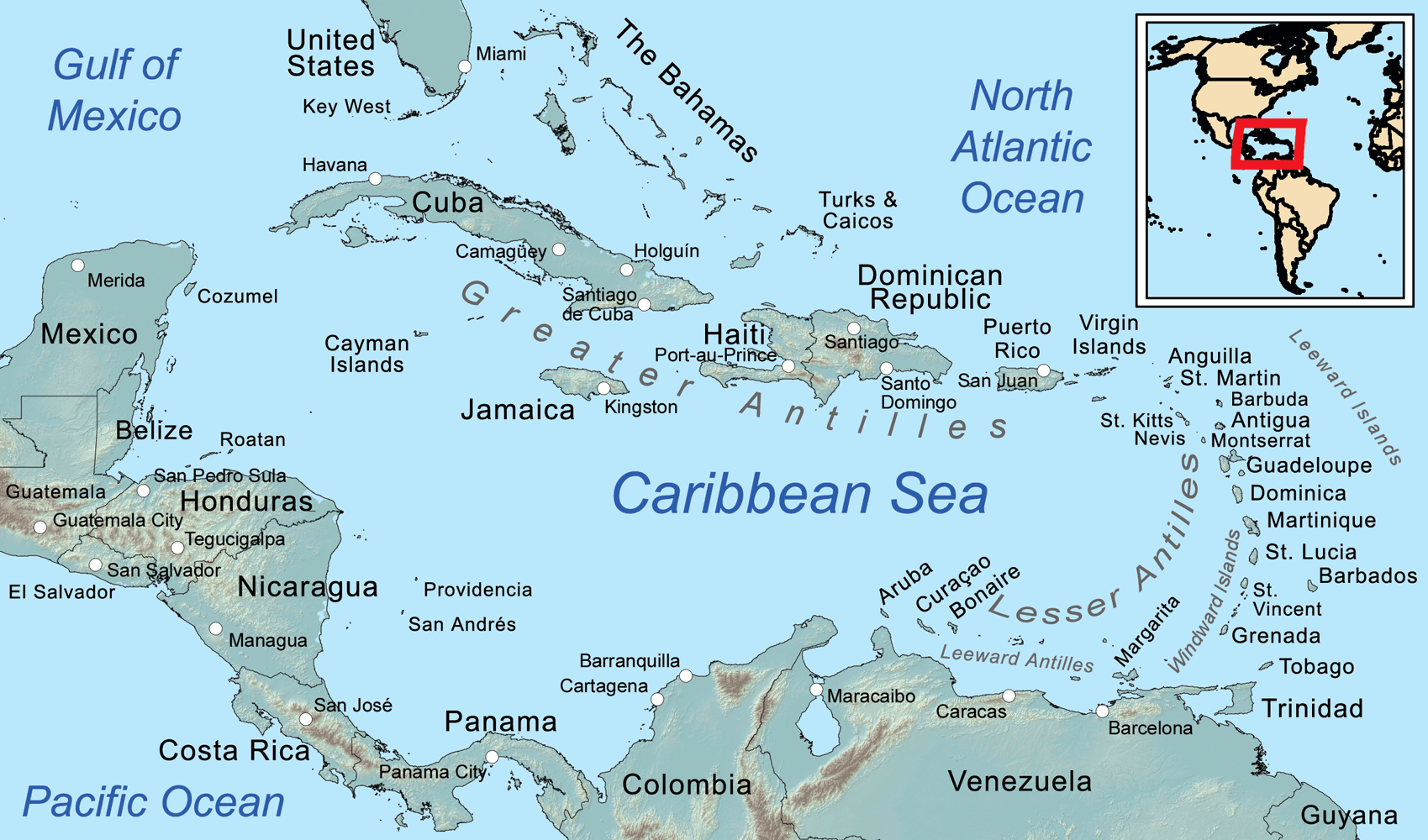
The Early Carribbean
N.E. of South America
Thirty Years’ War (1618-1648)
Dutch, Brazil (1630-40), Suriname
French St Domingue (1659) & English Jamaica (1655)
- Tropical Crops
- Started settling in Northern part of South America (above Brazil).
- English, French, Dutch all created small colonies there
- They were also a safe haven to then attack Spanish/Portuguese shipping.
- The Dutch
- tried to copy the V.O.C.
- started the West India Company (1621)
- Due to 30 years’ war gave opportunity to taking over Spanish/Portuguese lands
- tried to expand by taking over Brazil
- successful from 1630 - 1640
- when that failed they took over Suriname from the English (1674)
- they applied the Brazilian system to Suriname (Dutch Guiana)
- grew cotton, coffee, cacao, and sugar.
- based on slave labor
- mixing the VOC system with the Brazilian system
- Caribbean Islands
- Most were depopulated by the Spaniards or under supported by the Spaniards.
- The colonies in N. of South America became jumping off points for slowly colonizing those islands
- For instance, many became refuges for colonists just trying to survive
- in 17c, they were rather underpopulated.
- Santo Domingo was controlled by Spanish
- The cattle they brought became overpopulated
- A great location for finding meat, tanning leather,
- Many French came there to smoke the beef on wooden frames called boucans.
- (buccaneers)
- Slowly the french colonists came to control the western part of Saint Domingue (1625), generally by privateers
- This was a common process of transformation in 17c Caribbean, esp. for french.
- By 1659, Saint Domingue formally colonized by France (French half of the island).
- For instance, many became refuges for colonists just trying to survive
Changes to the Economy
Economy (16th-17th c.)
- labor: Indentured Servants
- products: tobacco & cotton
Economy (17th-18th c.)
- labor: Enslaved Africans
- products: Sugar, Cacao, Coffee, Sugar
- Indentured Servants
- Most of the time the worked under an overseer for 5-7 year contracts
- They started raising tobacco or cotton
- Enslavement
- As they realized they could adopt the Dutch strategy and make large plantations. - they transitioned to enslaved labor, - Something the Portuguese were doing and the - Sugar demanded much greater labor - they found it in the slave trade - talk more about that next week
- British followed a similar pattern as the French
- Their most important became Jamaica (1655)
Mercantilism: Developed to Support War Efforts
Wealth is Finite: Silver, Gold
Jean-Baptiste Colbert (1619-1683)
Monopolies: Rights and Privileges
Trade Bubbles



- Governments viewed economies as a means to fund wars
- John Brewer’s article on the house of commons indicates this premise
- the power of parliament grew and gained increased centralized control over the country as a means to make war with France and defend its position.
- Mercantilism was economic warfare
- designed to support the war efforts
- designed to undermine the war effor of other countries.
- John Brewer’s article on the house of commons indicates this premise
- global wealth= finite
- wealth = metal (silver/gold)
- Do not import goods from other countries
- It sends money out of country.
- If you do not have access to mines; make a colony
- In the colony grow raw products (sugar, tobacco, rice)
- import those products to mother country
- monopolize colonial trade with mother country.
- sell finished goods
- finished goods leave country
- gold/silver enter country
- Same reason to monopolize trade with colonies
- Make sure colonies gold/silver only goes to mother country.
- Stage 1 is the Joint-stock company
- given a monopoly over trade in a region
- Jean-Baptiste Colbert
- Centralizing the organization of these policies
- Previously, business people got together and petitioned the crown for monopolies for their endeavors
- Colbert starts taking the lead in organizing the economy
- Organizing the creation of companies
- But when needed took direct control of colonies
- 1663 made New France a royal colony
- protecting domestic manufacturers
- Centralizing the organization of these policies
- England did similar behavior
- But it wasn’t controlled by the crown
- It was controlled by parliament.
- Stage 2 was - That monopoly came with responsibilities - Only trade with the mother country. - Do not trade with other countries in region. - If you need stuff, talk to mother country.
- Trade Bubble - colonies sell raw goods to mother country - mother country processes those products - sells manufactured goods to other countries and the colonies - Export stuff - Import money, gold, silver.
- France began colonizing Canada in the sixteenth century when Jacques Cartier sailed to the Saint Lawrence in 1534
- 17th century France began colonizing other areas: Caribbean in mid 1650s, and Louisiana in 1682.
- England first started colonizing North America in 1607 with Jamestown. Plymouth colony, Maine colony, Massachusetts bay colony and the province of Carolina (later - and S. in 1700s) in the 1620s. Later colonies around New York and New Jersey in the 1660s-1680s, and the last in Georgia in 1732.
- NB
- most colonization was a 17century process other than Spain and Portugal.